












What if your bullet journal could become your own personal library? A place to remember what you have read, what you thought of each book, what you loved, what you want to read next, and how your reading habits change over time.
That is exactly what a bullet journal book tracker can do. The next time someone asks you “read anything good lately?”, you will have something beautiful to show them.
What is a bullet journal book tracker?
A book tracker is a simple tool used to log the books you have read. When you keep one inside your bullet journal, you open up far more flexibility. You could use a dedicated dotted notebook just for reading, or add book spreads to your everyday journal so they are always on hand.
Most bullet journal book trackers help you do one or more of these things:
- Track what you have read, such as filling a virtual library with titles on one page
- Track how many books you have read, like 11 non-fiction books and 23 fiction books this year
- Track your thoughts on each book, from star ratings and summaries to favourite quotes and characters
It helps to know how this fits alongside other reading tools:
- A book tracker is usually a list, shelf or grid that shows what you have finished (or started).
- A reading journal goes further, with guided pages for reviews, goals, wish lists and reading progress.
- A book review journal focuses on reflection: ratings, summaries, quotes and what you would recommend to someone else.
- A reading habit tracker logs when and how much you read, such as daily pages or minutes, rather than every title.
A bullet journal book tracker is usually a DIY layout inside a dotted notebook. A reading journal does a similar job, but often gives you more structure, with guided pages for book reviews, reading goals, favourite quotes, wish lists and reading progress.
Why keep a bullet journal book tracker?
Reading can be brilliant for your wellbeing. A 2009 study found that 30 minutes of daily reading lowered stress in a similar way to yoga or humour. But a book tracker is useful for practical reasons too.
A good reading tracker or reading journal can help you:
- Remember book recommendations before you forget the title
- Choose what to read next when your to-be-read pile feels overwhelming
- Spot favourite genres, authors and themes across the year
- Track reading goals without turning reading into a chore
- Reflect on books more deeply once you have finished them
- Make reading feel more intentional, even if you only finish a few pages some days
One word of warning: do not be too hard on yourself. As with any goal, an unrealistic target can make reading feel stressful rather than enjoyable. Your book tracker should support your reading life, not judge it.
What you need to start a bullet journal book tracker
You do not need much to begin. Pick a notebook you enjoy writing in, gather your favourite pens, and choose a book (or a shortlist) to start with.
Then decide which approach suits you:
- Blank dotted journal if you enjoy designing your own layouts and want total creative freedom
- Guided reading journal if you want the structure already built in, with pages for reviews, goals, wish lists and progress tracking
If you like the idea of tracking your books but do not want to draw every spread from scratch, a guided Reading Journal can give you the same benefits with ready-made pages.
How to get started:
- Settle into a comfy corner where you actually want to journal.
- Decide what you will track: ratings, quotes, genres, pages read, or a simple finished list.
- Add any symbols to your bullet journal key if you are using rapid logging alongside your tracker.
- Create your first spread, or open your reading journal to the first review page.
- Start with the book on your bedside table and capture thoughts as you go.
For a custom bullet journal book tracker, a lined notebook or Luxe Pattern notebook works well. For a ready-made book journal, explore the reading journals collection.
18 bullet journal book tracker ideas
Whether you are building spreads from scratch or using a guided reading journal, these book tracker ideas and reading journal ideas should give you plenty to try. Pick one or two layouts that feel realistic, then build from there.
1. Create a virtual library
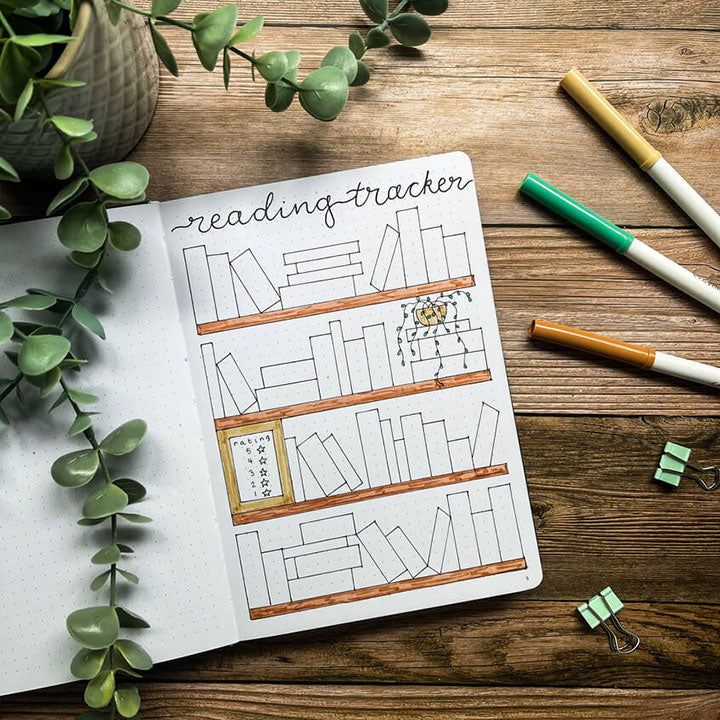
If a floor-to-ceiling home library is still on the wish list, draw a mini library inside your bullet journal instead. Add a shelf row for each month, or one big bookcase page you fill in as you finish books.
Try this: sketch simple book spines and write the title when you finish. At the end of the year, you have a visual reading log you can flick through in seconds.
The Yop & Tom Reading Journal includes a My Bookshelf visual tracker: shade in a book on the shelf for every title you finish. It gives you the same satisfaction as a drawn library, without starting from a blank page.
2. Plan your reads, month by month
Just as you might crave lighter meals in summer and cosier food in winter, your reading mood shifts too. A monthly plan helps you match books to the season and stops your to-be-read list from feeling endless.
Try this: give each month a short theme (travel, comfort re-reads, non-fiction, book club picks) and list two to four titles you would like to finish. Leave space to swap books if your mood changes.
In the Reading Journal, the Reading Wishlist (24 titles) and New Book Releases sections work well alongside a monthly plan in your bullet journal or planner.
3. Work your way through a series
Series reading is satisfying, but easy to lose track of, especially if you read more than one saga at once. A simple grid or checklist keeps you oriented without much upkeep.
Try this: list each book in the series in order and mark squares as you finish. Add a one-line note on your favourite instalment at the end of the year.
4. Rate your year (at a glance)
If you like reviewing books once you finish them, a star or number rating system helps you spot patterns quickly. You might notice you always love a certain author, or that one month was full of DNFs.
Try this: create a rating key in the front of your journal (for example, 1 = did not finish, 5 = new favourite). Log each title with its score on one index page.
The Reading Journal includes a Rating Legend plus a Book Index for 60 books with title, author, genre and rating, so your year-at-a-glance view is already set up.

5. Highlight your top reads each month
Breaking a yearly reading goal into monthly milestones makes it feel more achievable. A short end-of-month note also gives you a highlight reel to look back on.
Try this: at the end of each month, list your top one to three reads and one sentence on why they stayed with you. Link this to your habit tracker if you are logging reading days too.
6. Create an immersive world inside your bullet journal
If your dream reading nook does not exist yet, draw it. Add shelves, a armchair, a cup of tea, then fill the shelves with titles as you finish them.
Try this: keep the illustration simple so you actually finish it. A one-page scene with blank spines to colour in is enough to make this spread feel special.
7. Get granular and track your books inside a book
This is a playful meta idea: a mini book shape inside your journal, with one page inside for each title you want to read this season.
Try this: draw a small book outline on each spread and use the inside space for status (want to read, reading, finished), start date and a quick rating.
8. Theme your bullet journal bookshelf around each season
Seasonal shelves are a fun way to organise reading tracker ideas without a complicated layout. Spring might use florals, summer could feel bright and travel-led, and winter might lean into festive or cosy picks.
Try this: create four bookshelf pages (one per season) and only add books you read during that season. It is an easy way to see how your taste changes through the year.
9. Choose a more minimal style
The best book tracker is one you will use. A simple list beats an elaborate spread you abandon by February.
Try this: write title, author, date finished and rating in a running list. Tally your total at the bottom of each month. The Reading Journal Book Index works like a minimal list with room to grow into fuller reviews later.
10. Track your progress through each book
Life is too short to force yourself through every book. Tracking progress (pages read, chapters finished, or a simple half-full bar) lets you honour partial reads and notice when a book is not working.
Try this: add a progress bar to your weekly spread for your current read, or log page counts in a small grid.
The Reading Journal Annual Reading Tracker lets you colour each day based on pages read, with ranges from 0 pages up to over 70 pages. It is a reading habit tracker and book journal in one.

11. Turn each book into a spread
If you love reflecting on a story, give each finished book its own page: rating, summary, favourite quote, character notes and who you would recommend it to.
Try this: use the same review template every time so you never wonder what to write. That is exactly what a structured book review journal is for.
The Yop & Tom Reading Journal includes 60 individual review spreads with space for rating, summary, author, genre, dates started and finished, recommended by, recommend to, thoughts, and “my most loved” chapter, quote and character.
12. Turn your entire bullet journal into a book tracker
If reading is your main journaling focus, make the whole notebook a dedicated book journal. Add a contents page, a rating key and separate sections for TBR lists, reviews and stats.
Try this: reserve the first pages for your key and index, then alternate between monthly logs and review spreads. The Reading Journal is essentially this concept, pre-built.
13. Use your book tracker to remember recommendations
How many times has someone told you about a brilliant book, only for the title to vanish from memory a week later? A recommendations list fixes that.
Try this: keep a “recommended by” column next to each wish list title. When you finish the book, note whether you would pass it on to someone else.
The Reading Journal review spreads include recommended by and recommend to fields, plus a Reading Wishlist for up to 24 books with title, author and genre.
14. Combine your book tracker with your weekly spread
If you already bullet journal every week, add a small reading line to your weekly layout: current book, pages read, or minutes logged.
Try this: add a book icon to your weekly task list and log progress on Sundays. See our bullet journal setup guide if you are building your first weekly spread.
15. Track the time or daily progress you spend reading
Some months one long novel takes all your reading time. Tracking days or pages read (not just books finished) gives a fairer picture of your habit.
Try this: colour a small calendar square on days you read, or log daily page counts in a grid. Match colours to page ranges if you want more detail.
The Reading Journal Annual Reading Tracker uses page-count categories (0, 1–15, 16–30, 31–50, 51–70, and over 70 pages) so you can see busy reading weeks at a glance.
16. Bring it all together into a detailed monthly review
If you love stats, a monthly recap spread can include genres read, formats (paperback vs audiobook), average rating, favourite quote and books started vs finished.
Try this: pick three numbers that matter to you (books finished, pages read, five-star count) and review them on the last day of each month. Keep it short so you stick with it.
17. Create mini books inside your bullet journal
For a creative book journal idea, draw tiny book covers that flip open to reveal quotes or notes inside. It is time-consuming, but lovely for favourite reads you want to revisit.
Try this: limit this to one mini book per month so it stays fun. Use it for standout titles rather than every library loan.
18. Track what you loved (and what you did not)
It is tempting to only record five-star reads, but noting books you did not enjoy is useful too. Over time you spot patterns: tropes you are tired of, genres that rarely work for you, or authors that always deliver.
Try this: add a simple “would recommend?” yes/no field to every review. The Reading Journal rating system, review pages and notes section at the back all help you compare books honestly.

Blank bullet journal or guided reading journal: which is best?
There is no wrong answer. It depends on how much time you want to spend on layout design versus reading itself.
Blank dotted journal
- Best for creative, custom spreads
- Flexible layout for any book tracker idea
- Ideal if you enjoy drawing bookshelves, banners and decorative headers
- Takes more setup time before you start tracking
Guided Reading Journal
- Best if you want to start quickly
- Consistent review pages every time
- Includes goals, wish lists, challenges and progress trackers built in
- Good for reviews, stats and reading habits in one place
The Yop & Tom Reading Journal is designed for readers who want the joy of book tracking without creating every page from scratch. Browse all styles in our reading journals collection, or pair a dotted notebook from our notebooks range with the ideas above.

What’s inside the Yop & Tom Reading Journal?
Think of it as a complete book lover’s companion. Alongside classic bullet journal book tracker functions, it includes guided sections for almost every idea in this list:
- Reader Info with contact details, photo space and favourite book, author, character, genre and quote prompts
- Reading Goals for yearly targets, number of books, number of pages, top five books to read and personal goals
- Reading Wishlist for up to 24 books (title, author, genre)
- New Book Releases for up to 24 upcoming titles with release dates
- Rating Legend so you can define your own 1–5 star system
- Book Index for 60 books with title, author, genre and rating
- 60 review spreads with summary, dates, recommendations, thoughts and favourite quote, chapter and character
- Most Loved Authors for eight authors and why you return to them
- Book Borrowing & Lending Tracker for library loans and books lent to friends
- Reading Challenge section for up to 100 books (sketch covers or list titles)
- My Bookshelf visual tracker to shade in each finished book
- Annual Reading Tracker to colour daily page counts
- Notes pages at the back for anything that does not fit a template
It works whether you want a structured reading journal, a book review journal, or a reading tracker that also logs daily habits.
Is a reading journal a good gift?
Yes, especially for someone who already loves books and stationery. A reading journal makes a thoughtful present for:
- Book lovers and avid readers
- Book club friends who swap recommendations
- Teachers and students building a reading habit
- Anyone trying to read more this year
- People who use Goodreads but still want a physical log
- Stationery fans who enjoy a beautiful notebook on the shelf
Explore gifts for book lovers and our reading journals collection for covers and styles to match their taste.
FAQs
What is a bullet journal book tracker?
It is a layout inside a bullet journal (usually a dotted notebook) where you log books you have read, want to read, or are currently reading. It can be as simple as a list or as detailed as review spreads with quotes and ratings.
What should I include in a book tracker?
At minimum: title, author and date finished. Many readers also add ratings, genre, favourite quotes, who recommended the book, and a short summary. A reading journal template includes these fields ready to fill in.
What is the difference between a book tracker and a reading journal?
A book tracker usually focuses on logging titles. A reading journal adds structure for goals, wish lists, reviews, borrowing notes and reading habits. Both help you remember what you have read; a reading journal goes deeper.
How do I track books I want to read?
Keep a TBR (to be read) list with title, author and where the recommendation came from. In the Yop & Tom Reading Journal, use the Reading Wishlist and New Book Releases sections, then move titles to review spreads when you finish them.
How many books can I track in a reading journal?
It depends on the journal. The Yop & Tom Reading Journal includes a book index and individual review pages for 60 books, plus a reading challenge section for up to 100 titles.
Is a reading journal good for book clubs?
Yes. Use it to note meeting dates, club picks, your rating and discussion points. The recommend to and recommended by fields are especially handy when everyone swaps suggestions.
Can a reading journal help me read more?
It can, if you use it kindly. Tracking pages or reading days builds awareness without needing a strict book-a-week goal. Pair it with realistic targets from the Reading Goals section.
Should I use a blank journal or a guided reading journal?
Choose a blank dotted notebook if you enjoy designing spreads. Choose a guided reading journal if you want to start immediately with review pages, wish lists and trackers already laid out. Many readers use both over time.
Want more journaling inspiration? Read our guides to 21 types of journaling, bullet journal keys, and habit trackers. For wider journal options, browse journals across Yop & Tom.