












Your bullet journal key is a staple component of your bullet journaling practice. Whilst it might not feel like the most exciting or creative part of your practice, the key acts as the foundation for everything you write and create inside your journal, so it’s important to get it right.
What is a bullet journal key?
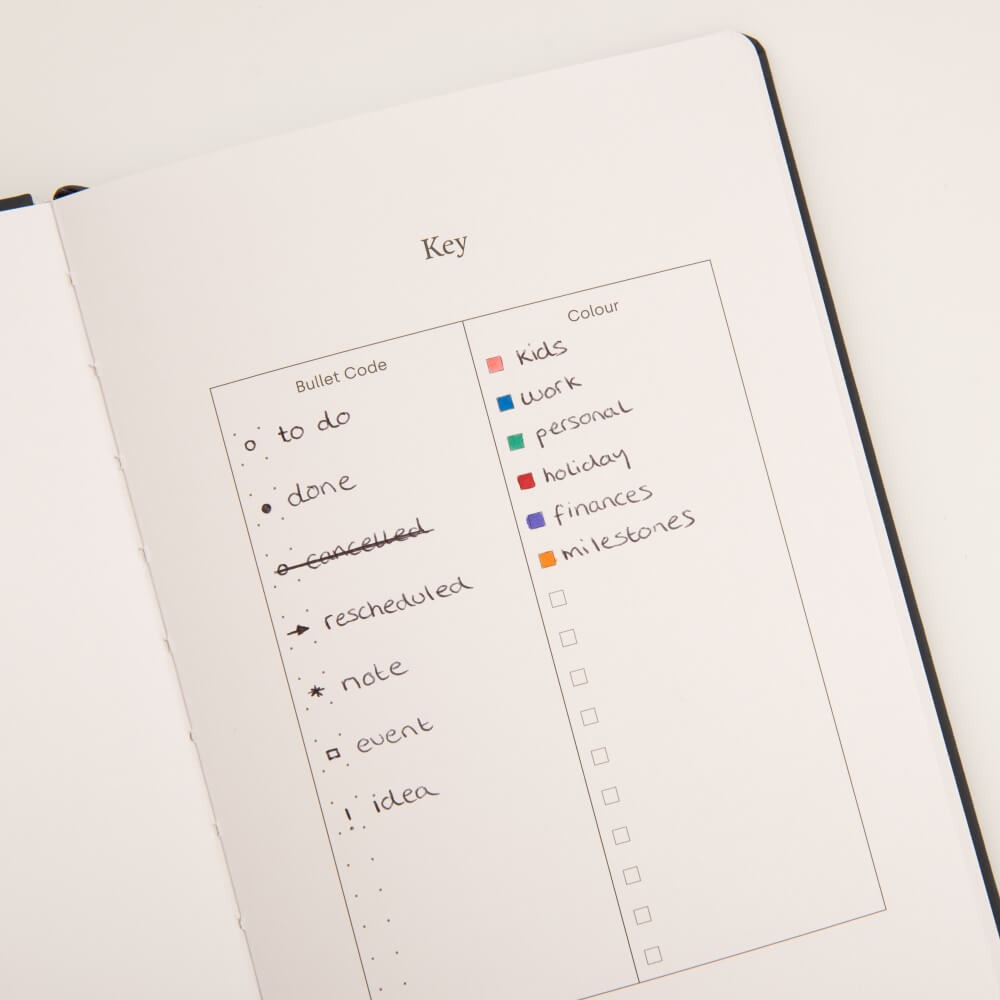
A bullet journal key is a page at the start of your bullet journal where you keep track of the symbols, colours or other signifiers you use to represent various tasks and ideas stored inside your journal.
As with all bullet journaling, your key can be customised to meet your unique needs. You can build it around the way you use your bullet journal, updating and evolving it as you go. So you can use rapid logging to get your thoughts down onto paper, in the easiest way possible.

The original: Ryder Carroll’s bullet journal key
The original bullet journal key comes from Ryder Carroll, the creator of the bullet journaling system. Since bullet journaling was originally intended to be very minimal and simple, Ryder Carroll’s key is exactly that. It goes straight to the point.

And that’s it! Each symbol has been selected to help you get your thoughts down onto paper fast. The idea is that the symbol dictates the type of idea, so all you need to do is write the accompanying thought.
Your bullet journal key will become a resource that you refer back to each time you use your journal, unlocking the potential of the bullet journaling practice with every use. However, you’ll likely find that, after some practice, you’ll start to remember what each symbol means without having to check back with your bullet journal key.
This practice is known as rapid logging, Ryder Carroll’s incredible system behind bullet journaling.
How to create a bullet journal key that works for you
Our favourite thing about bullet journaling is that it offers a blank canvas, with a simple system that can be customised to suit your needs. This means that your bullet journal’s key can grow and evolve as you do.
Since the key is an integral part of the bullet journal set-up process, it helps to consider how you’re going to use your journal when you’re designing your key. What will the purpose of your bullet journal be? This will dictate the type of key you need.
Here’s how to create a bullet journal key that’s just as unique as you are:
- Set the purpose for your bullet journal. Will you be covering just one area of your life e.g. school or art projects? Or will you be journaling every aspect of your life?
- Write a list of everything you expect to journal, from to-do lists to habit trackers, playlists and everything in between. Get it all down on paper.
- Group this “mega list” into types of notes. Is there anything that could be combined into the same note type e.g. school tasks and home tasks?
- Assign each note type a unique symbol and add it to your bullet journal key.
- Choose your colour codes. If you’re journaling different areas of your life, you could categorise these by colour e.g. red for school, green for home, and so on. Or, use your colour codes to assign different priority levels to your notes.
There you go! You’ve just created your key. Need some more inspiration? Read on for our favourite bullet journal key ideas to get you inspired.
Bullet journal key symbols to get you inspired
Whilst Ryder Carroll’s bullet journal key acts as a great foundation for your journaling system (especially if you’re a fan of the minimalist aesthetic), there are plenty of ways you can build off it by creating key symbols of your own.
If you need some ideas to get you started, here are some favourites inspired by the way our Yop & Tom community use their journals.
Related: 8 Bullet Journaling Fonts You Have To Try (For Every Level)
- ⏰ = deadline
- 💡 = ideas
- ⏳ = task in progress
- 💰 = financial target
- 😀 = mood status
- 📺 = TV show
- 🎵 = song or playlist
- 📗 = reading list
- 💙 = goals
- 🕯️ = birthday
Minimalist bullet journal key ideas
Even more bullet journal key ideas
Remember, your bullet journal’s key is likely to change over time, as your bullet journaling practice changes too.
If in doubt, start with a key that’s relatively simple and try to use symbols that are easy to remember. It’s far easier to add more symbols in than to take them away — nobody wants a messy key at the start of their bullet journal!
What will you unlock with your key?
Our wellness journals and lined notebooks are built for bullet journaling — many include an outlined key section so you can start from day one. Prefer a guided format? Browse our planners and journals for layouts with structure built in.
Ready to set up your spread? Explore wellness journals and our bullet journaling guide, or read our guides to bullet journal setup, 21 types of journaling, and habit trackers.